Shares 2
The Reasons Why Dakar Rally Motorcycles Use Three Fuel Tanks
Last updated on 04-Mar-2026 , By Badhon Roy
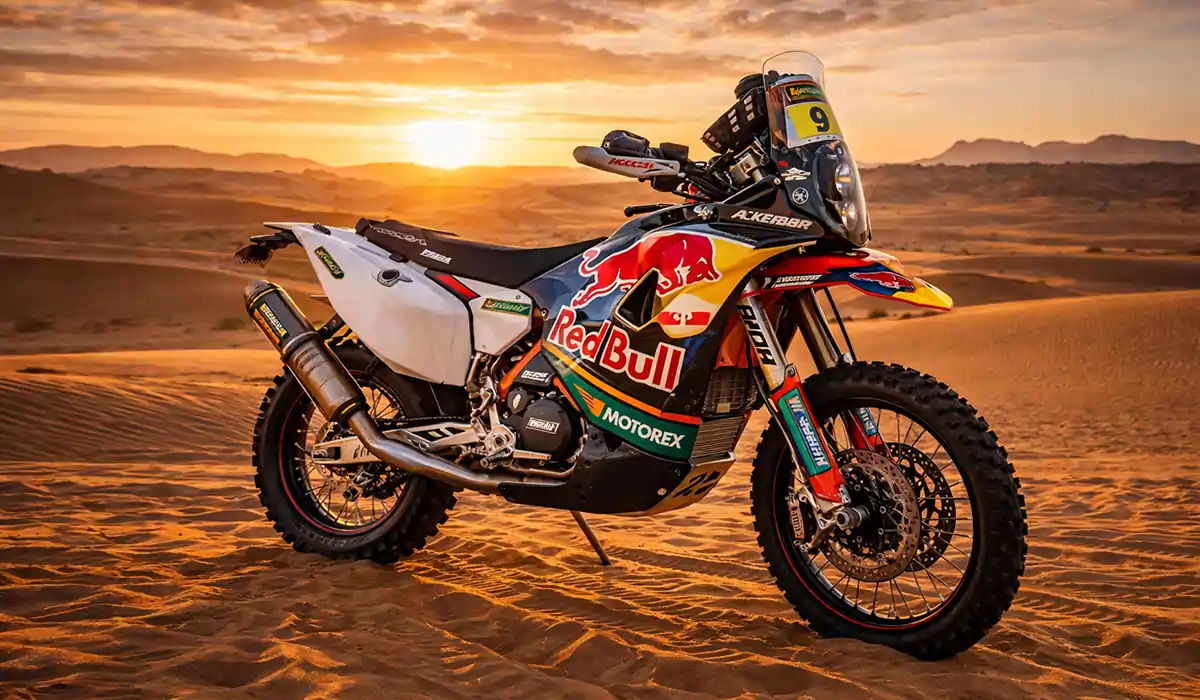
The Dakar Rally is not just a motorsport event. It is a true test of human and machine endurance in extreme environments. These motorcycles are built for intense off road conditions. Many people do not know that Dakar rally bikes usually use a total of three fuel tanks. At first glance this may seem excessive but in reality, there are strong practical needs and deep scientific and engineering reasons behind this design. So, today we will try to understand these technical explanations.
The Reasons Why Dakar Rally Motorcycles Use Three Fuel Tanks
The use of three fuel tanks can be divided into several key factors. These include the lack of refueling facilities over long distances harsh environments heat transfer engineering balance and several other related issues.
In each stage of the Dakar Rally a motorcycle often has to run continuously for about 250 to 450 kilometers. Along these routes there is frequently no fuel station or technical support available. As a result carrying around 20 to 35 liters of fuel on a single bike becomes mandatory. If such a large amount of fuel were stored in one single large tank it would severely affect the bike’s balance and control. This is where the need for multiple tanks comes from.
From an engineering perspective the most critical factor is the bike’s center of gravity. Fuel is a variable mass. As the bike moves fuel is consumed and its quantity reduces which changes the weight distribution. When all the fuel is stored in one large tank the center of gravity shifts rapidly. At high speeds and while riding on sand this creates stability problems. By distributing fuel across three tanks the change in weight becomes slower and more controlled allowing the bike to maintain consistent handling for longer periods.
Another closely related concept is mass centralization. On Dakar bikes two fuel tanks are usually mounted low on the front left and right sides while the third tank is positioned near the chassis at the rear. This keeps the overall mass closer to the center of the bike and reduces the moment of inertia. As a result quick direction changes on sand or avoiding sudden obstacles becomes much easier.

Also Read: All Motorcycle Price In Bangladesh
Another scientific reason for using multiple fuel tanks is fuel sloshing. In a large tank liquid fuel shifts aggressively during hard braking or acceleration creating unpredictable forces that disturb balance. Splitting the fuel into smaller tanks significantly reduces this effect and makes handling more predictable.
Structural considerations also play an important role. Around 30 liters of fuel weighs roughly 22 to 24 kilograms. If this weight is carried by a single tank with limited mounting points it puts extreme stress on the frame during jumps or heavy impacts. Dividing the fuel among three tanks spreads the load more evenly across the chassis which improves load distribution and reduces the risk of frame fatigue or cracking over a long race.
Heat management is another major concern. Continuous riding in high temperatures increases the risk of heat soak and vapor lock in the fuel system. Multiple tanks increase the surface area allowing heat to dissipate more easily which improves overall fuel system reliability.
Finally there is the issue of reliability. In the Dakar Rally a single mechanical failure can end the entire race. With multiple fuel tanks even if one tank is damaged the rider may still be able to use fuel from the remaining tanks to finish the stage. This level of engineering redundancy significantly increases the chances of completing the race.
Overall the three fuel tanks on Dakar Rally motorcycles are not just for carrying extra fuel. They are a complete engineering solution to ensure balance control heat management and reliability. This is why Dakar bikes not only look different but are also technically and structurally very different from regular motorcycles.
For all known and unknown information related to bikes and motorcycling stay with BikeBD.
T
Published by Badhon Roy
About Badhon Roy
Writer



Best Bikes
Price: 169800
Price: 255000
Price: 212000